Funnels leak. Flywheels compound. Gifting behaves like a flywheel when each stage feeds the next, turning one purchase into two customer relationships and a repeatable loop.
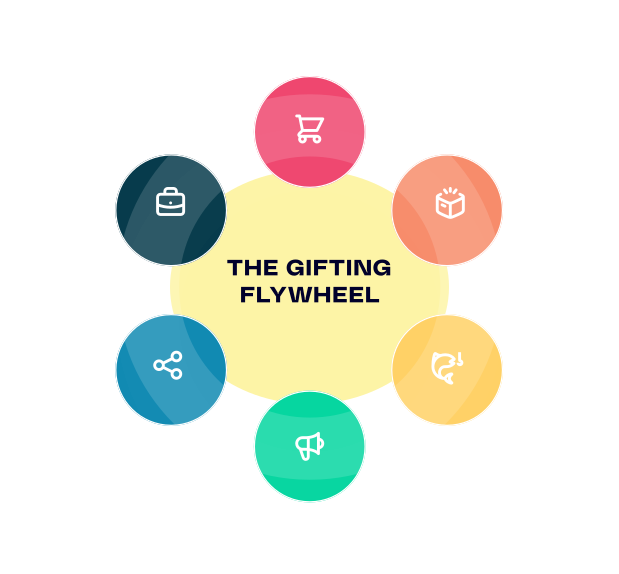
Flywheel
A funnel ends at purchase. A flywheel starts there. The goal is to capture recipient attention, convert it into identity, and turn both buyers and recipients into repeat givers.
Stages
Checkout
Make gifting obvious and easy. A clear CTA, a simple gift note flow, and optional scheduling do more than lift conversion. They also unlock better data collection later in the loop.
Unboxing
The unboxing is the first physical interaction with your brand. A personalized message and a trackable insert are not extras. They are the bridge from offline to online.
Capture
The moment a recipient scans a QR or watches a video message is the moment to capture identity. That is the handoff from attention to a measurable relationship.
Retain
Recipients are warm. Treat them like referrals and use a short, high-intent nurture sequence instead of a generic welcome flow. For more on measurement, see Package Insert Attribution.
Multiply
When a recipient converts, they are likely to send gifts of their own. That creates the compounding loop. Even a modest conversion rate lowers blended CAC.
Scale
Corporate volume compresses the loop. A single account can create hundreds of recipients with one order, which makes the flywheel spin faster when the operations are ready.
KPIs
You cannot grow what you do not measure. These eight metrics give you the minimum viable dashboard.
| KPI | Definition | Why it matters | How to measure |
|---|---|---|---|
| Recipient conversion | Percent of recipients who make a first purchase in your attribution window | This is your multiplier | Match recipient identifiers to first purchases after gift delivery |
| Gift CAC | Gifting program cost divided by gifting-attributable new customers | Shows whether gifting beats blended CAC | Include tech, ops, inserts, and incentives in the numerator |
| Gift adoption | Percent of orders using a gifting feature | Shows channel penetration | Divide gift-flagged orders by total orders |
| Gift margin | Gifting revenue minus gifting-specific costs | Confirms profitable scale | Subtract COGS, labor, print, and tool costs from gifting revenue |
| Recipient opt-in | Percent of recipients who share contact details | Unlocks lifecycle marketing | Track QR visits to successful email or SMS capture |
| Gift AOV lift | AOV for gift orders vs standard orders | Quantifies upsell impact | Compare AOV cohorts with and without gifting enabled |
| Gifting frequency | Gifts sent per gifter over 12 months | Indicates repeat behavior and loop strength | Total gifts sent divided by unique gift buyers |
| Viral coefficient | New gifting-attributed customers per gifting customer | Measures flywheel compounding | Divide gifting-attributed new customers by gifting participants |
Keep the table above as your "single screen" dashboard. The sections below explain how to interpret each KPI, what commonly breaks, and how to measure it without fooling yourself.
Recipient Conversion
Definition: Percent of recipients who make a first purchase within your attribution window.
Why it matters: This is the multiplier. It is the cleanest proof that gifting creates new customers.
How to measure: Choose a window (for example, 30 days after delivery). Match recipient identifiers (email, phone, hashed identity, or a unique QR visit that later becomes an opt-in) to first purchases.
Common pitfalls include counting existing customers as "new" because identity resolution is weak, or using an attribution window that is too short for your category.
Gift CAC
Definition: Total gifting program cost divided by gifting-attributed new customers.
Why it matters: Lets you compare gifting to blended CAC and justify investment.
How to measure: Include platform costs, print and materials, labor delta, incentives, and creative/ops time. Divide by new customers you can attribute to gifting.
Gift Adoption
Definition: Percent of orders that use a gifting feature.
Why it matters: Shows channel penetration. If adoption is low, you have a discovery and UX problem.
How to measure: Decide what qualifies (gift note, delivery scheduling, multi-recipient checkout, gift insert personalization). Track gift-flagged orders / total orders.
Gift Margin
Definition: Gifting revenue minus gifting-specific costs.
Why it matters: Confirms profitable scale. Gifting is not a channel if it destroys contribution margin.
How to measure: Subtract COGS plus gifting-specific costs (print, materials, labor delta, reprints) from gift-order revenue, then compare to non-gift cohorts.
Recipient Opt-In
Definition: Percent of recipients who share contact details.
Why it matters: Unlocks lifecycle marketing and cleaner attribution.
How to measure: Track the conversion rate from QR landing page visit to successful email or SMS capture.
Gift AOV Lift
Definition: AOV for gift orders vs standard orders.
Why it matters: Quantifies upsell impact and helps fund the program.
How to measure: Compare AOV cohorts with and without gifting enabled, controlling for seasonality when possible.
Gifting Frequency
Definition: Gifts sent per gifter over 12 months.
Why it matters: Indicates repeat behavior and the strength of the loop. It also guides retention strategy (reminders, reorders, micro-occasions).
How to measure: Total gifts sent / unique gift buyers over a rolling window.
Viral Coefficient
Definition: New gifting-attributed customers per gifting participant.
Why it matters: Measures compounding. It is the difference between a seasonal bump and an owned channel.
How to measure: New gifting-attributed customers / gifting participants (buyers + converted recipients), using a consistent attribution model.
Setup
Start simple.
- Add unique QR codes to gift inserts and tie scans to a recipient flow.
- Track new buyers that match recipient identifiers within a defined window.
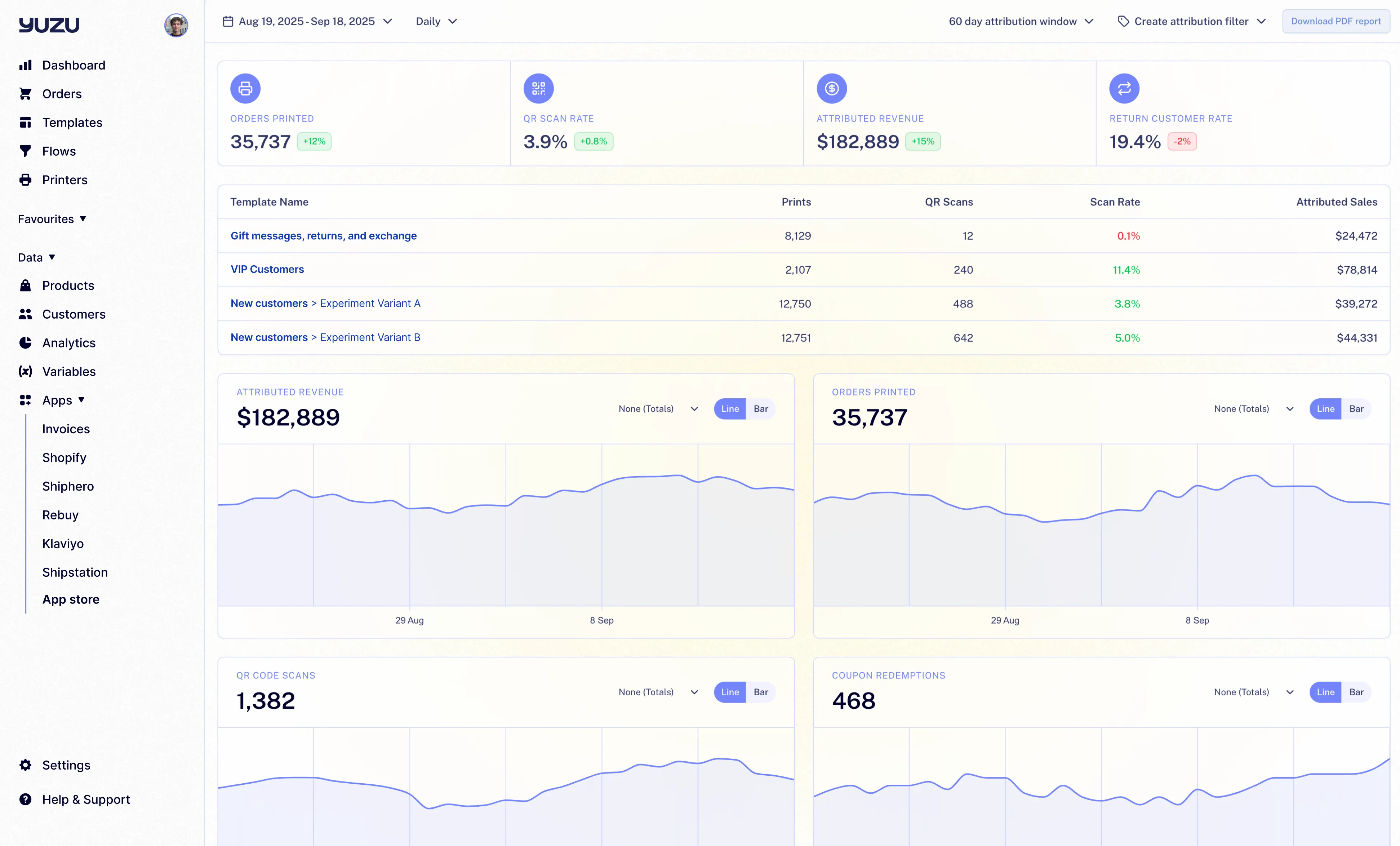
- Use a single dashboard view for opt-ins, scans, and first purchases.
If you want a practical testing framework, see A/B Testing Package Inserts. For broader strategy context, see Gifting as a Growth Engine.
Here is an example of the type of dashboard view you want in place before scaling the channel.